
Plumbing Invoice Template and Payment Terms
Use this plumbing invoice template to bill labor, materials, service calls, emergency work, payment terms, and approved extras clearly.
by Eng. José Manuel Siso Colmenares • 6/24/2026 · Updated: 9/22/2026
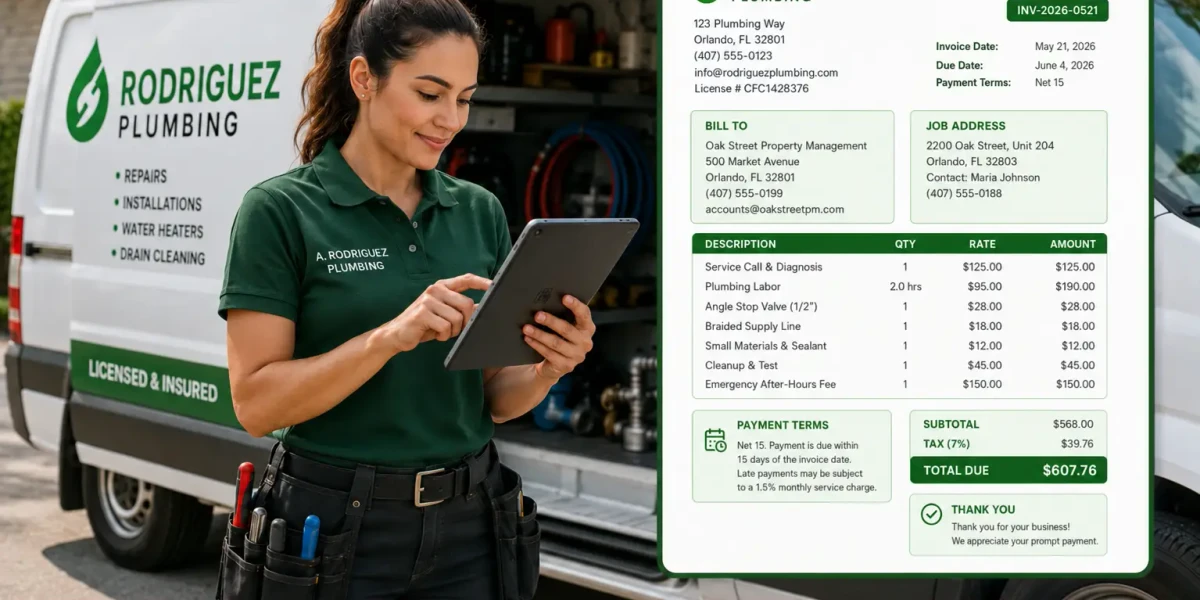
You finished the repair. The leak is fixed, the new fixture is installed, the client is happy, and your tools are already back in the truck. The only thing left is getting paid, and that is where too many plumbers lose momentum.
Because the invoice still says:
Plumbing work: $850That single line looks simple, but it quietly invites delay. The homeowner wonders what was included. The property manager wants the material breakdown. The accounting team needs a job address to file it. The builder asks for a billing period. Someone questions the service call fee, and the vendor bill in your inbox no longer matches what you charged. Each of those questions is a day, or a week, that your money sits in someone else’s account.
That is exactly why plumbers need clear invoices backed by firm payment terms. A detailed bill is the cheapest collections tool you have.
By the end of this guide, you will have a complete plumbing invoice template you can copy today, plus the payment terms, line items, and language to bill service calls, labor, materials, emergency work, and approved extras without the back-and-forth.
Quick answer: A plumbing invoice should show who performed the work, where the work was done, what was repaired or installed, which materials were used, how labor was billed, what payment terms apply, and how much is due.
Why plumbing invoices need more detail than a basic bill
From the outside, plumbing work can look simple. A client sees a faucet replaced, a drain cleared, a toilet reset, a water heater installed, or a leak repaired, and assumes that is all they are paying for.
You see the real job behind it:
- Drive time.
- Diagnosis.
- Access problems.
- Shutoff issues.
- Materials.
- Specialty fittings.
- Old pipe condition.
- Disposal.
- Cleanup.
- Testing.
- Warranty notes.
- Emergency response time.
When none of that is documented, the invoice feels vague, and a vague invoice is an easy one to set aside until “later.”
The good news is that demand for plumbing work stays strong. The U.S. Bureau of Labor Statistics projects employment for plumbers, pipefitters, and steamfitters to grow 4 percent from 2024 to 2034, with about 44,000 openings per year on average. BLS plumbing outlook That steady demand is an opportunity, but it also raises the stakes: the more jobs you run, the more you need a professional billing system that actually protects your cash flow.
The payment delay problem
Slow payment is one of the biggest, quietest threats in construction. Rabbet reported that slow and inconsistent payments cost the U.S. construction industry $299 billion in 2025. Rabbet 2025 Construction Payments Report
For plumbers, that pain hits harder than most, because you usually front the money first. Fuel, parts, labor, insurance, vehicle costs, and supplier accounts all come due before the client’s check clears. A clear invoice will not solve every payment problem, but it removes the avoidable ones, the simple questions that turn a five-day pay cycle into a five-week one.
💡 Contractor rule: The faster a client understands the invoice, the faster they can approve payment.
What a plumbing invoice template should include
A strong plumbing invoice template answers six questions at a glance:
- Who performed the work?
- Who is being billed?
- Where was the work completed?
- What work was done?
- What materials or parts were used?
- When and how should payment be made?
Miss any one of these and you give the client a reason to pause. Hit all six and the invoice practically approves itself. Here is what each section should contain.
Contractor information
Start with your business details so the client knows exactly who they are paying. Include:
- Company name.
- Logo.
- Business address.
- Phone number.
- Email.
- Website.
- License number when applicable.
- Tax ID when needed.
- Insurance or warranty note when appropriate.
This makes the invoice look professional and gives clients your details on file for the next time something leaks, clogs, or fails.
Client and job information
Plumbers rarely bill just one kind of customer. Over a typical month you might invoice:
- Homeowners.
- Landlords.
- Property managers.
- Builders.
- General contractors.
- Commercial tenants.
- Restaurants.
- Multifamily communities.
- Maintenance companies.
The person who let you in is often not the person who pays the bill. A property manager schedules the work, a tenant meets you onsite, and a corporate accounting office cuts the check. That is why your invoice should clearly separate billing information from job information.
Example:
| Field | Example |
|---|---|
| Client | Oak Street Property Management |
| Billing address | 500 Market Avenue, Orlando, FL |
| Job address | 2200 Oak Street, Unit 204 |
| Contact onsite | Maria Johnson |
| Invoice number | INV 2026 0521 |
| Service date | May 21, 2026 |
| Payment terms | Due Upon Receipt |
This small habit prevents a lot of confusion when the same client owns or manages several properties.
Service description
The service description is where you turn “trust me” into “here is what I did.” Compare the two versions below.
Weak description:
Plumbing repairBetter description:
Diagnosed active leak under kitchen sink, replaced failed angle stop valve, installed new braided supply line, tested for leaks, and cleaned work area.The second version is easier to understand, and it quietly justifies the price. When a client can picture the work, they rarely argue about the total.
Labor
List labor clearly so the client can see what they are paying for. Depending on the job, you might bill labor as:
- Flat rate.
- Hourly rate.
- Service call plus labor.
- Emergency labor.
- Minimum charge.
- Project milestone.
- Crew day rate.
Example:
| Labor item | Quantity | Rate | Total |
|---|---|---|---|
| Service call and diagnosis | 1 | $125 | $125 |
| Plumbing labor | 2 hours | $95 | $190 |
| Emergency after hours labor | 1 | $150 | $150 |
Even if you price by the flat rate, you can still spell out what that labor covered. Clients pay flat-rate invoices faster when they understand what is bundled inside the number.
Materials and parts
List materials whenever they carry real cost or explain the job. Common plumbing parts include:
- Angle stops.
- Supply lines.
- P trap.
- PVC fittings.
- Copper fittings.
- PEX fittings.
- SharkBite fittings.
- Valves.
- Wax rings.
- Toilet flange.
- Drain assembly.
- Faucet.
- Garbage disposal.
- Water heater parts.
- Pipe insulation.
- Caulk.
- Sealant.
- Pipe dope.
- Straps and hangers.
Itemized materials show the client that they are paying for more than your time, which makes the total feel fair instead of inflated.
Taxes, discounts, and fees
Give every charge its own clear line:
- Sales tax when applicable.
- Discount.
- Permit fee.
- Disposal fee.
- Trip charge.
- Parking fee.
- Emergency fee.
- Credit card fee when allowed by law.
- Late fee when allowed by agreement.
Never bury fees inside a vague total. A fee you can point to and explain is a fee you can defend; a hidden one just looks like padding.
Payment terms
Payment terms tell the client exactly when payment is due, and they are the part of the invoice plumbers most often forget. QuickBooks explains that Net terms refer to how many days the buyer has to pay after the invoice date, such as Net 7, Net 15, or Net 30. QuickBooks payment terms guide
For plumbing contractors, the right terms depend on the type of job and the type of client:
| Job type | Suggested payment terms |
|---|---|
| Small service call | Due Upon Receipt |
| Emergency repair | Due Upon Receipt |
| Repeat property manager | Net 7 or Net 15 |
| Builder or GC work | Net 15 or Net 30 |
| Water heater replacement | Deposit plus balance on completion |
| Repiping job | Deposit plus progress payments |
| Commercial project | Contract based progress billing |
Wherever the terms land, keep them visible right next to the total, not buried in the footer where nobody reads.
Plumbing invoice template you can copy
Use the structure below as your starting point. Copy it into your invoicing tool or document and fill in the blanks for each job.
PLUMBING INVOICE

Contractor:
Company name:
Business address:
Phone:
Email:
License number:
Website:

Client:
Client name:
Billing address:
Phone:
Email:

Job:
Job address:
Unit:
Service date:
Technician:
Job number:
Invoice number:
Invoice date:
Due date:
Payment terms:

Scope of work:
Describe the plumbing work completed.

Labor:
Service call:
Diagnosis:
Repair labor:
Installation labor:
Emergency labor:

Materials:
Part:
Quantity:
Unit price:
Total:

Summary:
Subtotal:
Tax:
Discount:
Total due:
Amount paid:
Balance due:

Notes:
Payment instructions:
Warranty notes:
Exclusions:
This template covers service calls, repair work, replacements, and smaller plumbing projects without any extra effort. For larger jobs, just add sections for deposits, progress billing, change orders, and retainage where they apply.
Plumbing invoice example
To see the template in action, here is a realistic service invoice for a common job.
- Project: kitchen sink leak repair
- Client: residential homeowner
- Service date: May 21, 2026
- Payment terms: Due Upon Receipt
Scope of work
Diagnosed active leak under kitchen sink. Removed failed angle stop valve and damaged supply line. Installed new quarter turn angle stop and braided stainless steel supply line. Tested water supply under pressure and confirmed no visible leak at completion. Cleaned work area.Invoice line items
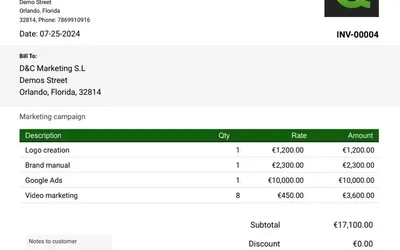
| Item | Quantity | Rate | Total |
|---|---|---|---|
| Service call and diagnosis | 1 | $125 | $125 |
| Plumbing labor | 2 hours | $95 | $190 |
| Quarter turn angle stop valve | 1 | $28 | $28 |
| Braided supply line | 1 | $18 | $18 |
| Small materials and sealant | 1 | $12 | $12 |
| Cleanup and test | 1 | $45 | $45 |
Subtotal: $418
Tax: as applicable Total due: $418 plus applicable tax
Compare that to the version most clients actually receive:
Kitchen sink repair: $418Same price, completely different feel. The itemized invoice explains the value and gives the client far fewer reasons to question, delay, or dispute the bill.
Plumbing payment terms that protect cash flow
Your payment terms should match the risk and size of each job. Small plumbing businesses run on tight cash flow, because parts, fuel, insurance, tools, payroll, and supplier accounts all have to be paid whether or not the client has paid you yet.
The numbers back this up. A 2025 survey reported that 70 percent of contractors experienced payment delays, and 10 percent said those delays lasted more than 30 days. To cope, many leaned on credit, negotiated longer supplier terms, or cut back on bidding. New York Post contractor payment survey
In other words, you cannot afford soft payment language. Here are the terms that work best for plumbing, and when to use each one.
Due Upon Receipt
Best for:
- Emergency repairs.
- Small service calls.
- One time residential clients.
- Jobs under a set minimum.
- After hours work.
Example wording:
Payment is due upon receipt of this invoice. Thank you for your prompt payment.Due Upon Receipt works best when the job is finished, the client is standing right there, and there is no reason for them to wait.
Net 7
Best for:
- Repeat homeowners.
- Small property managers.
- Regular maintenance clients.
- Trusted commercial clients.
Example wording:
Payment is due within 7 days of the invoice date.Net 7 gives the client a short administrative window without creating a long cash flow gap.
Net 15
Best for:
- Property managers.
- Builders.
- General contractors.
- Small commercial accounts.
- Repeat B2B clients.
Example wording:
Payment is due within 15 days of the invoice date.Net 15 is often more reasonable for companies that process invoices through accounting.
Net 30
Best for:
- Larger commercial clients.
- Builders with established payment cycles.
- Government or institutional work.
- Contract based jobs.
Use Net 30 carefully.
If your margins are tight and material costs are high, waiting 30 days for payment can quietly squeeze your cash flow, so reserve it for clients whose payment cycles you trust.
Deposit plus balance
Best for:
- Water heater replacement.
- Repiping work.
- Bathroom rough in.
- Large fixture installation.
- Jobs with special order materials.
- Jobs requiring permits.
Example:
| Milestone | Payment |
|---|---|
| Deposit before scheduling | 40 percent |
| Rough in completion | 30 percent |
| Final trim and test | 30 percent |
A structure like this keeps you from financing the entire job out of your own pocket while you wait for the final check.
Progress payments
For larger plumbing projects, progress payments keep the money flowing in step with the work. For example:
| Billing milestone | Payment |
|---|---|
| Deposit and material order | 25 percent |
| Underground or rough in phase | 35 percent |
| Inspection ready phase | 25 percent |
| Final trim and completion | 15 percent |
This way your cash flow stays aligned with the work actually completed, instead of arriving all at once at the very end.
Plumbing invoice line items by job type
No two plumbing jobs bill the same way. A quick service call needs far less detail than a full repipe, so use the checklists below to match your invoice to the work.
Service call invoice
Include:
- Service call fee.
- Diagnosis.
- Labor.
- Parts.
- Testing.
- Cleanup.
- Payment terms.
Example line:
Service call and diagnosis for leaking toilet at Unit 204.Drain cleaning invoice
Include:
- Service call.
- Drain location.
- Equipment used.
- Access point.
- Labor.
- Result.
- Limitations.
- Camera inspection if performed.
Example note:
Drain cleared through cleanout access. No warranty applies if blockage is caused by pipe damage, root intrusion, foreign objects, or improper use.Water heater invoice
Include:
- Existing unit removal.
- New water heater.
- Supply lines.
- Shutoff valve.
- Pan when needed.
- Expansion tank when required.
- Permit when applicable.
- Disposal.
- Startup and test.
Example line:
Remove existing 50 gallon electric water heater and install new 50 gallon electric water heater with required connections, test, and disposal.Repiping invoice
Include:
- Project address.
- Areas included.
- Pipe material.
- Fixture count.
- Wall access.
- Shutoff replacement.
- Testing.
- Drywall exclusions.
- Inspection notes.
- Progress billing.
Repiping invoices need this extra detail because the scope is large and usually touches several rooms, so the more clearly you document each phase, the smoother the billing goes.
New construction plumbing invoice
Include:
- Project phase.
- Rough in.
- Top out.
- Trim out.
- Fixture count.
- Plan reference.
- Change orders.
- Inspection status.
- Retainage if applicable.
- Billing period.
On work this size, job-based invoicing stops being a nice-to-have and becomes essential.
How to create a plumbing invoice in QuickAdmin
The reason QuickAdmin works so well for plumbers is simple: a plumbing invoice should never live in isolation from the job that created it. When the estimate, scope, labor, materials, and payment status all share one record, billing stops being a separate chore.
For most plumbers, the cleanest workflow looks like this:
- Create the job.
- Create the estimate or invoice inside the job.
- Add the client.
- Add scope of work.
- Add labor and materials.
- Add payment terms.
- Add notes and exclusions.
- Send the invoice.
- Track payment.
- Sync with QuickBooks Online when needed.
Follow it and the whole project stays organized from quote to payment. Here is each step in detail.
Step 1: Create the job
Start by creating a job for the plumbing work. Clear, specific job names save you headaches later, for example:
- Kitchen sink leak repair.
- Water heater replacement, Unit 204.
- Bathroom rough in, Building B.
- Drain cleaning, restaurant kitchen.
- Repipe, Oak Street residence.
- Final trim plumbing, Lot 18.
- Multifamily plumbing repair phase 2.
Then enter the project address. This step matters more than it seems, because plumbers frequently run several jobs for the same client across different properties, and the address is what keeps them straight.
Step 2: Create the invoice inside the job
With the job created, build the invoice directly from that job record. Add:
- Invoice title.
- Job selection.
- Billing period.
- Payment terms.
- Scope description.
- Labor and materials.
- Approved extras or change orders.
- Notes and exclusions.
Building it this way keeps the invoice locked to the right project, client, job address, billing period, and approved work, so nothing gets billed to the wrong account.
Step 3: Add labor and materials
Enter labor and materials as clear, separate line items. For example:
| Item | Quantity | Rate | Total |
|---|---|---|---|
| Plumbing labor | 3 hours | $95 | $285 |
| Service call | 1 | $125 | $125 |
| New shutoff valve | 1 | $28 | $28 |
| Supply line | 1 | $18 | $18 |
| Disposal and cleanup | 1 | $45 | $45 |
A breakdown like this makes the invoice easy to review and almost impossible to argue with.
Step 4: Add notes and exclusions
Notes are quiet protection for the contractor. A few well-placed lines set expectations and head off disputes before they start:
- Work area tested with no visible leak at completion.
- Existing plumbing condition may affect future performance.
- Drain cleaning warranty excludes root intrusion and damaged pipe.
- Drywall repair is not included unless listed.
- Tile repair is not included unless listed.
- Additional work requires separate approval.
- Fixtures supplied by owner are not covered by contractor material warranty.
These notes are not legal advice, just practical language that helps clients understand the limits of what they are paying for.
Step 5: Send and track the invoice
Send the invoice as soon as the work wraps up, while the job is still fresh in the client’s mind. A clear subject line helps it get opened:
Invoice INV 2026 0521 for kitchen sink leak repairAnd a short, friendly message does the rest:
Attached is the invoice for the plumbing repair completed today at the job address listed. The invoice includes the service call, labor, installed materials, testing, and cleanup. Payment terms are listed on the invoice.The pattern is consistent across every plumbing business: the faster you invoice, the faster you get paid.
QuickAdmin vs a basic plumbing invoice template
A blank template is great for producing a single document. But running a plumbing business takes more than a document, it takes a job-based workflow that connects the estimate, the invoice, and the payment. Here is how the options stack up.
| Feature | Blank template | Spreadsheet | QuickAdmin |
|---|---|---|---|
| Create plumbing invoice | Yes | Manual | Yes |
| Save client details | No | Manual | Yes |
| Connect invoice to job | No | Manual | Yes |
| Add labor and materials | Manual | Manual | Yes |
| Add payment terms | Manual | Manual | Yes |
| Track payment status | No | Manual | Yes |
| Attach files and notes | No | Limited | Yes |
| Convert estimate to invoice | No | No | Yes |
| Create job records | No | Manual | Yes |
| QuickBooks integration | No | No | Yes |
| Built for contractor workflow | No | No | Yes |
A template creates a bill. QuickAdmin manages the whole workflow from estimate to invoice to payment, which is what actually protects your time and your margin.
Common plumbing invoice mistakes to avoid
A good plumbing invoice gets you paid; a weak one just generates questions. These are the mistakes that most often slow plumbers down, and how to fix each one.
Mistake 1: Using vague descriptions
Bad:
Plumbing work completed.Better:
Replaced leaking angle stop valve under bathroom sink, installed new supply line, tested for leaks, and cleaned work area.Specific descriptions are your best defense against disputes.
Mistake 2: Forgetting payment terms
Never leave the client guessing about when to pay. Spell it out:
Payment due upon receipt.or:
Payment due within 7 days of invoice date.Either way, make sure the terms are easy to spot.
Mistake 3: Not listing materials
If the job required parts, list them. Even when you group small supplies into one line, show enough detail to explain where the charge came from.
Mistake 4: Not separating approved extras
When a client approves extra work mid-job, give it its own line so the original scope stays clean. For example:
| Approved extra | Amount |
|---|---|
| Replace second shutoff valve requested by client | $145 |
| Add disposal replacement during service visit | $325 |
Folding extras into the original scope only invites confusion and pushback later.
Mistake 5: Not recording the job address
This one trips up plumbers constantly with property managers and builders, who manage many addresses at once. Always include the job address and unit number so your invoice can be matched to the right property.
Mistake 6: Waiting too long to invoice
Every day you wait to send the invoice is a day payment slips further out. Bill as soon as the work is complete, while the client still remembers the value you delivered.
Plumbing invoice language you can copy
Keep these short, ready-to-use clauses on hand and drop them into invoices whenever they fit.
Payment due clause
Payment is due according to the terms listed on this invoice.Due upon receipt clause
Payment is due upon receipt unless different terms were approved in writing.Service completion clause
Work listed on this invoice was completed at the job address shown above.Leak test clause
Completed work was tested for visible leaks at the time of service.Existing condition clause
This invoice covers the work listed above and does not include unrelated existing plumbing conditions unless specifically stated.Owner supplied fixture clause
Owner supplied fixtures are installed as provided and are not covered by contractor material warranty.Drain cleaning limitation clause
Drain cleaning service does not guarantee performance where pipe damage, root intrusion, improper slope, or foreign objects are present.Related guides for stronger contractor workflows
To turn this invoice template into a complete estimate-to-payment system, explore these related QuickAdmin guides:
- Estimate Software for Contractors
- How to Make an Invoice
- Why PWA billing and estimating is the future
- 5 Ways Estimate Software Saves Time for Busy Plumbers
- Job Costing Software for Small Contractors
Every one of these articles reinforces the same workflow: estimate accurately, document the job, invoice clearly, track payment, and protect your profit.
Conclusion: a plumbing invoice should make payment easy
A plumbing invoice is far more than a receipt for work completed. It is the document that explains the job, justifies the charge, sets the payment expectation, and ultimately protects your cash flow.
When something is missing, you feel it. A vague invoice invites questions. Missing payment terms invite delay. Unlisted materials make the total feel unclear. A missing job address leaves property managers unable to approve it. Folded-in extras turn a routine bill into a dispute. A clear, detailed invoice quietly removes all of those friction points before they cost you a single day.
With QuickAdmin, plumbers can create job-based invoices, add labor and materials, set payment terms, document approved extras, attach notes, track payment status, and connect accounting workflows with QuickBooks Online, all from one place.
The routine is simple: create the job, add the scope, list labor and materials, set the payment terms, send the invoice fast, and track payment clearly. That is how plumbing contractors get paid in full with far less back-and-forth.
Next step for plumbers: Plumbing estimation software guide · Estimate & invoice software for plumbers; create the job-linked invoice in QuickAdmin. Start free (6 estimates / 3 invoices per month).
FAQ
What is a plumbing invoice template?
A plumbing invoice template is a structured billing document that helps plumbers charge for service calls, labor, materials, fixtures, emergency work, approved extras, taxes, payment terms, and balance due.
What should a plumbing invoice include?
A plumbing invoice should include contractor information, client information, job address, invoice number, service date, labor, materials, parts, diagnosis, scope of work, taxes, payment terms, and total amount due.
What payment terms should plumbers use?
Many plumbers use Due Upon Receipt for small service calls, Net 7 or Net 15 for repeat clients, and deposits or progress payments for larger plumbing jobs.
Should plumbers itemize materials on invoices?
Yes. Itemizing materials such as valves, fittings, pipe, fixtures, supply lines, disposal, and specialty parts helps clients understand the work and reduces payment disputes.
Can QuickAdmin create plumbing invoices?
Yes. QuickAdmin helps plumbers create job based invoices, add labor and materials, include payment terms, attach notes, track payment status, and connect workflows with QuickBooks Online.
What is the difference between a plumbing estimate and a plumbing invoice?
A plumbing estimate explains expected cost before the work is approved. A plumbing invoice requests payment after the work is completed or after an approved billing milestone.
Should plumbers charge a service call fee?
Yes. A service call fee helps cover travel, diagnosis, scheduling, vehicle cost, insurance, and the time required to inspect the plumbing issue.
Does QuickAdmin integrate with QuickBooks?
Yes. QuickAdmin integrates with QuickBooks Online to help contractors streamline invoices, bills, and accounting related workflows.