
HVAC Estimate Software and Invoice Workflow
Estimate

HVAC Estimate Software and Invoice Workflow

Learn how HVAC contractors estimate installs, repairs, service calls, equipment, labor, add ons, payment terms, and invoices clearly.

by Eng. José Manuel Siso Colmenares • 7/19/2026 · Updated: 7/19/2026

hvac estimate software and invoice workflow for contractors 2026

HVAC Estimate Software and Invoice Workflow

Updated: Jul 19, 2026.

An HVAC estimate is not just a number. It is a decision document. The customer wants to know why a repair costs $485, why a replacement costs $8,900, why a diagnostic fee applies, why equipment availability matters, and why the final invoice should match what was approved. That means you need more than a price on a page: you need a workflow that starts at the service call and ends with a clean invoice.

Here is the question this guide answers:

How do you build an HVAC estimate that is detailed enough to protect your margin, but simple enough for the customer to approve quickly?

By the end, you will have an HVAC estimate software and invoice workflow for service calls, repairs, replacements, equipment installs, add ons, payment terms, and final billing.

Quick answer: HVAC estimate software should help contractors price labor, equipment, materials, refrigerant, permits, warranty notes, add ons, and payment terms, then convert the approved estimate into an invoice without retyping the job.

Key facts from this guide:

  • HVAC mechanic and installer employment is projected to grow 8 percent from 2024 to 2034, much faster than average (U.S. Bureau of Labor Statistics).
  • The average household spends more than $2,200 a year on energy bills, with nearly half going to heating and cooling (ENERGY STAR).
  • An HVAC estimate should separate five cost categories: labor, equipment, materials, refrigerant, and permits or code items.
  • HVAC contractors need three distinct workflows: service call and repair, equipment replacement, and maintenance agreements.
  • Equipment replacements should use a deposit before ordering equipment, with the balance due at completion.

Why HVAC estimates are different from basic service estimates

HVAC work has a problem most clients do not see. The visible part is simple:

  1. The AC is not cooling.
  2. The furnace is not heating.
  3. The thermostat is not responding.
  4. The system needs replacement.
  5. The customer wants the price.

The contractor sees the real variables:

  1. Diagnosis time.
  2. System age.
  3. Access.
  4. Equipment size.
  5. Duct condition.
  6. Refrigerant type.
  7. Electrical work.
  8. Drain line condition.
  9. Code requirements.
  10. Warranty limits.
  11. Permit needs.
  12. Labor risk.
  13. Return trips.
  14. Seasonal urgency.

That is why a generic invoice app is usually not enough. HVAC contractors need estimate software that follows how the job actually moves from inspection to approval to invoice.

The market context raises the stakes. The U.S. Bureau of Labor Statistics projects employment for heating, air conditioning, and refrigeration mechanics and installers to grow 8 percent from 2024 to 2034, much faster than the average for all occupations (BLS HVAC outlook). ENERGY STAR also notes that the average household spends more than $2,200 a year on energy bills, with nearly half going to heating and cooling (ENERGY STAR HVAC savings calculator).

That makes HVAC pricing sensitive. The customer is not only buying a repair or installation; they are making a decision about comfort, energy use, reliability, and cost.

The HVAC estimate framework: diagnose, explain, price, approve

Use this simple framework for every HVAC estimate.

StageWhat the contractor doesWhat the customer needs
DiagnoseInspect system, issue, access, and failure pointClear explanation
ExplainDescribe the repair or replacement optionConfidence in the scope
PriceAdd labor, equipment, materials, and termsTransparent total
ApproveSend estimate and collect approvalEasy yes or no decision
InvoiceConvert approved work into an invoiceClean payment request

This is different from simply writing:

HVAC repair: $650

A better estimate says:

Diagnostic fee: $125
Replace failed capacitor: $185
Electrical inspection and testing: $95
System operation test: $75
Payment terms: Due Upon Receipt

That level of detail makes the invoice easier to approve later.

What HVAC estimate software should calculate

HVAC estimate software should help contractors price the work without forgetting the real cost categories.

Labor

Labor is not just installation time. It can include:

  1. Diagnostic visit.
  2. Travel.
  3. System inspection.
  4. Equipment removal.
  5. Equipment installation.
  6. Electrical connection.
  7. Brazing or line set work.
  8. Drain work.
  9. Thermostat setup.
  10. Startup and testing.
  11. Warranty registration.
  12. Return trip.
  13. After hours service.
  14. Helper or second technician.

Example labor table:

Labor itemQuantityRateTotal
Diagnostic visit1$125$125
Lead technician labor3 hours$115$345
Helper labor3 hours$65$195
System test and startup1$95$95

Labor should be detailed enough to show value, but not so complicated that the customer gets lost.

Equipment

Equipment is usually the largest HVAC cost. Include:

  1. Condenser.
  2. Air handler.
  3. Furnace.
  4. Heat pump.
  5. Evaporator coil.
  6. Mini split indoor unit.
  7. Mini split outdoor unit.
  8. Thermostat.
  9. Zone control.
  10. Humidifier.
  11. Air purifier.
  12. Drain pump.

Example:

EquipmentQuantityTotal
3 ton heat pump condenser1$3,250
Matching air handler1$2,100
Smart thermostat1$245

If equipment is subject to availability, say so on the estimate.

Materials

Materials are often underestimated. Common HVAC materials include:

  1. Line set.
  2. Disconnect.
  3. Whip.
  4. Pad.
  5. Float switch.
  6. Drain line.
  7. PVC fittings.
  8. Copper fittings.
  9. Nitrogen.
  10. Refrigerant.
  11. Filter drier.
  12. Duct transitions.
  13. Mastic.
  14. Tape.
  15. Hangers.
  16. Fasteners.
  17. Sealant.
  18. Insulation.

Small materials may look minor, but they add up. Do not hide them inside vague pricing unless your flat rate already accounts for them.

Refrigerant

Refrigerant should be handled clearly. Depending on the job, include:

  1. Refrigerant type.
  2. Pounds added or recovered.
  3. Leak repair scope.
  4. Recovery fee.
  5. Recharge.
  6. Testing.
  7. Exclusions.

Example:

Recharge system with up to 2 lbs refrigerant after approved repair. Additional refrigerant or leak repair outside listed scope requires separate approval.

Some HVAC work may require permits, inspections, or code related upgrades. Include when applicable:

  1. Permit fee.
  2. Inspection fee.
  3. Electrical correction.
  4. Condensate drain correction.
  5. Equipment stand.
  6. Hurricane pad or tie down.
  7. Smoke detector or safety shutoff when required.
  8. Duct code correction.
  9. Access correction.

Do not let code related work become free work.

Warranty notes

Warranty language should be clear. Include:

  1. Manufacturer warranty.
  2. Labor warranty.
  3. Parts warranty.
  4. Exclusions.
  5. Maintenance requirements.
  6. Owner supplied equipment exclusions.
  7. Warranty registration responsibility.

Example:

Manufacturer warranty applies according to manufacturer terms. Labor warranty applies only to work listed on this estimate and invoice.

HVAC estimate template you can copy

Use this structure for service calls, repairs, and replacements.

HVAC ESTIMATE TEMPLATE

Contractor:
Company name:
Business address:
Phone:
Email:
License number:
Website:

Client:
Client name:
Billing address:
Phone:
Email:

Job:
Job address:
Unit:
System location:
Estimate number:
Estimate date:
Estimate valid until:
Prepared by:

System information:
System type:
Brand:
Model:
Serial number:
Age:
Tonnage or capacity:
Refrigerant type:
Service issue:

Scope of work:
Describe the diagnosis, repair, replacement, or installation.

Labor:
Diagnostic fee:
Technician labor:
Helper labor:
After hours labor:
Startup and testing:

Equipment:
Equipment item:
Model:
Quantity:
Price:

Materials:
Line set:
Drain material:
Electrical material:
Refrigerant:
Duct material:
Small materials:

Permits and fees:
Permit:
Inspection:
Disposal:
Equipment delivery:

Add ons:
Approved add ons:
Pending add ons:
Excluded work:

Payment terms:
Deposit:
Balance due:
Net terms:
Payment instructions:

Estimate total:
Tax:
Discount:
Total:

This template works because each estimate section can become an invoice section later, which means less retyping and fewer missed charges.

Three HVAC workflows contractors should separate

Do not use the same estimate structure for every HVAC job. HVAC contractors usually need three distinct workflows, each with different pricing risks.

1. Service call and repair workflow

Best for:

  1. No cool calls.
  2. No heat calls.
  3. Capacitor replacement.
  4. Contactor replacement.
  5. Thermostat issue.
  6. Drain clog.
  7. Low refrigerant.
  8. Fan motor issue.
  9. Blower motor issue.
  10. Basic electrical issue.

Pricing focus:

  1. Diagnostic fee.
  2. Labor.
  3. Parts.
  4. Testing.
  5. Payment due.

Example scope:

Diagnose no cool issue, replace failed capacitor, inspect electrical connections, test system startup, verify cooling operation at completion.

2. Equipment replacement workflow

Best for:

  1. Condenser replacement.
  2. Air handler replacement.
  3. Furnace replacement.
  4. Heat pump replacement.
  5. Full system replacement.
  6. Mini split installation.
  7. Package unit replacement.

Pricing focus:

  1. Equipment.
  2. Labor.
  3. Materials.
  4. Removal.
  5. Disposal.
  6. Permit.
  7. Startup.
  8. Warranty.
  9. Deposit.

Example scope:

Remove existing air handler and condenser. Install new matched heat pump system, reconnect existing duct transition where reusable, install new pad, reconnect electrical whip, complete startup, and verify operation.

3. Maintenance agreement workflow

Best for:

  1. Seasonal tune ups.
  2. Residential maintenance plans.
  3. Commercial maintenance.
  4. Filter service.
  5. Coil cleaning.
  6. Multi unit inspection.
  7. Property manager service.

Pricing focus:

  1. Frequency.
  2. System count.
  3. Included services.
  4. Exclusions.
  5. Billing period.
  6. Renewal terms.

Example scope:

Maintenance plan includes two scheduled visits per year for basic system inspection, filter check, condensate drain check, coil visual inspection, electrical inspection, and operating test. Repairs are billed separately unless listed.
Definition: HVAC repair estimates price a specific problem, HVAC replacement estimates price equipment and installation, and HVAC maintenance estimates price recurring inspection and service over a defined period.

HVAC estimate example

Here is a realistic replacement estimate so you can see how the pieces fit together.

  • Project: residential heat pump replacement
  • System: 3 ton split heat pump
  • Payment terms: 40 percent deposit, balance due upon completion
  • Estimate validity: 15 days

Scope of work

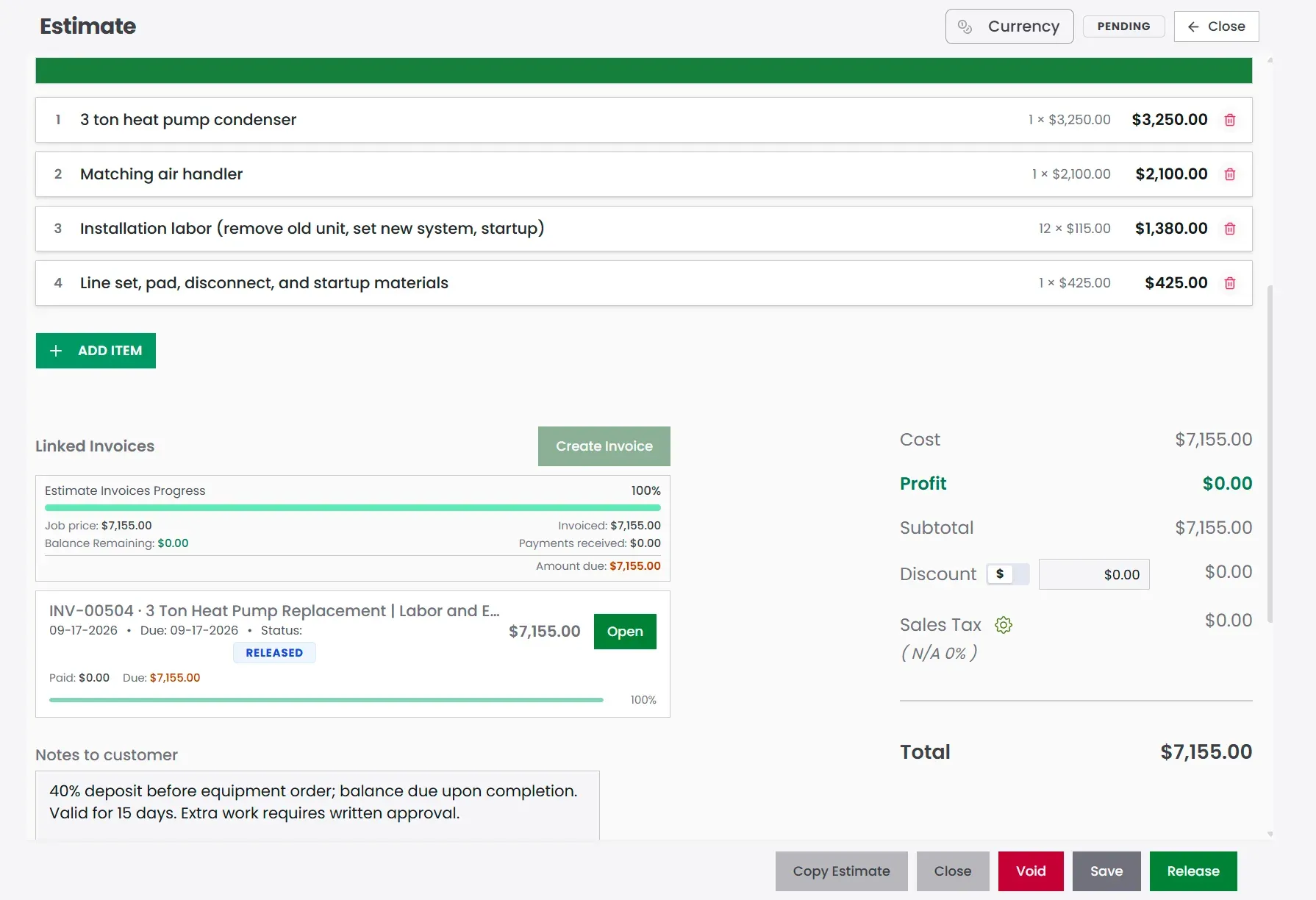
Remove existing outdoor condenser and indoor air handler. Install new matched 3 ton heat pump system, reconnect existing duct transition where possible, install new equipment pad, reconnect electrical whip and disconnect where reusable, install float switch, complete startup, test heating and cooling modes, and remove old equipment from jobsite.

Estimate line items

ItemQuantityRateTotal
3 ton heat pump condenser1$3,250$3,250
Matching air handler1$2,100$2,100
Installation labor12 hours$115$1,380
Helper labor8 hours$65$520
Electrical and drain materials1$425$425
Equipment pad and small materials1$285$285
Startup and system test1$175$175
Removal and disposal1$250$250
  • Subtotal: $8,385
  • Tax: as applicable
  • Estimated total: $8,385 plus applicable tax

Exclusions

This estimate does not include duct replacement, major electrical panel work, drywall repair, structural modification, crane service, hidden code corrections, or work not listed in the approved scope.

This estimate is clear enough for approval and structured enough to become an invoice.

How to turn an HVAC estimate into an invoice

The best HVAC workflow is:

  1. Create the job.
  2. Add client and job address.
  3. Create the estimate inside the job.
  4. Add system information.
  5. Add scope, labor, equipment, and materials.
  6. Add exclusions and warranty notes.
  7. Send the estimate.
  8. Get approval.
  9. Complete the work.
  10. Add approved add ons.
  11. Convert the estimate into an invoice.
  12. Track payment.
  13. Sync with QuickBooks Online when needed.

This workflow avoids scattered details and keeps the invoice tied to the approved scope.

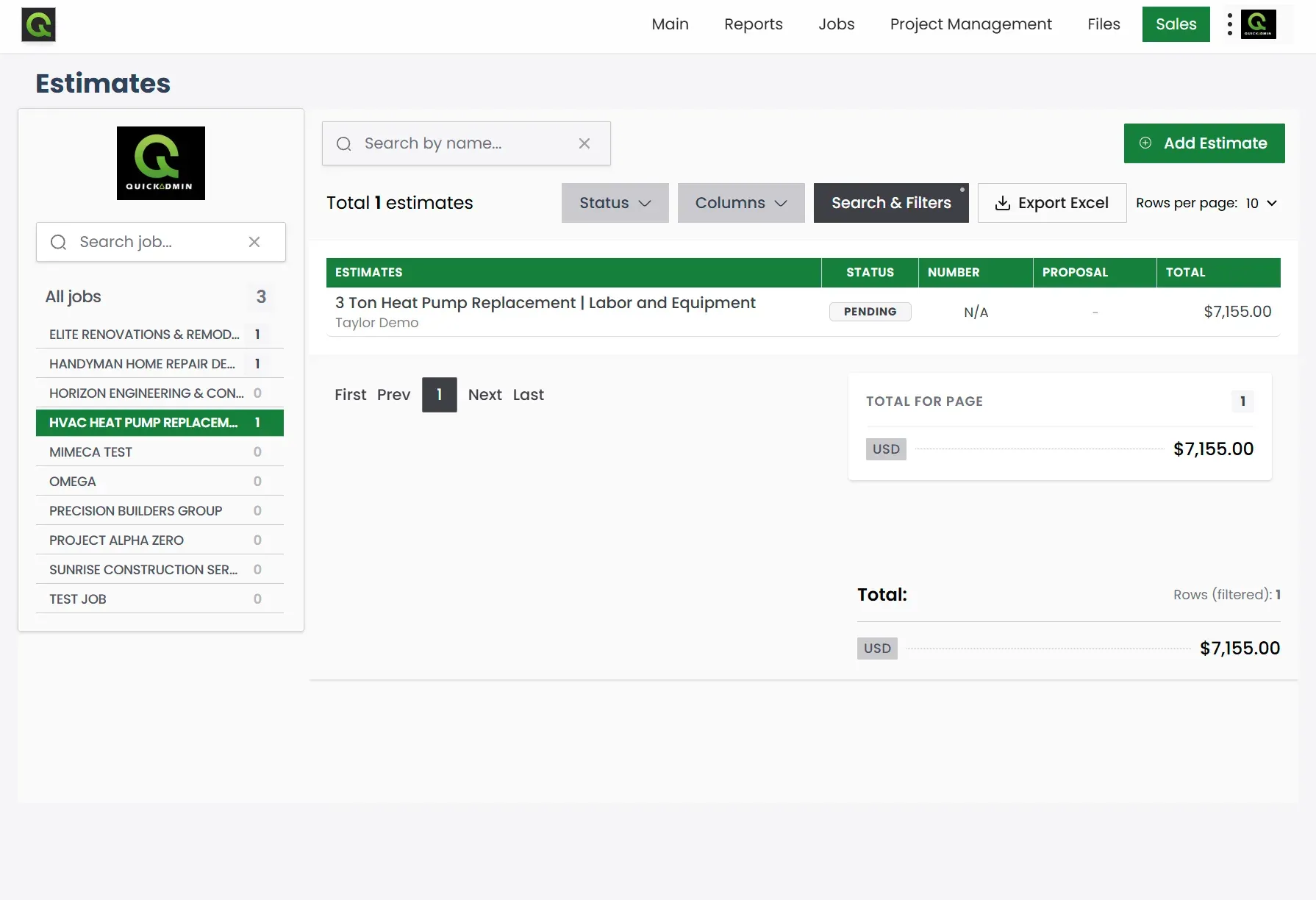
Step 1: Create the job

Create a job for the HVAC work.

Example job names:

  1. Smith no cool repair.
  2. Oak Street heat pump replacement.
  3. Building B seasonal maintenance.
  4. Restaurant rooftop unit repair.
  5. Mini split installation, garage apartment.
  6. Property manager AC service, Unit 204.
  7. Commercial filter service, Suite 18.

Enter the job address as well. For HVAC, the job address matters because the billing client may manage several properties.

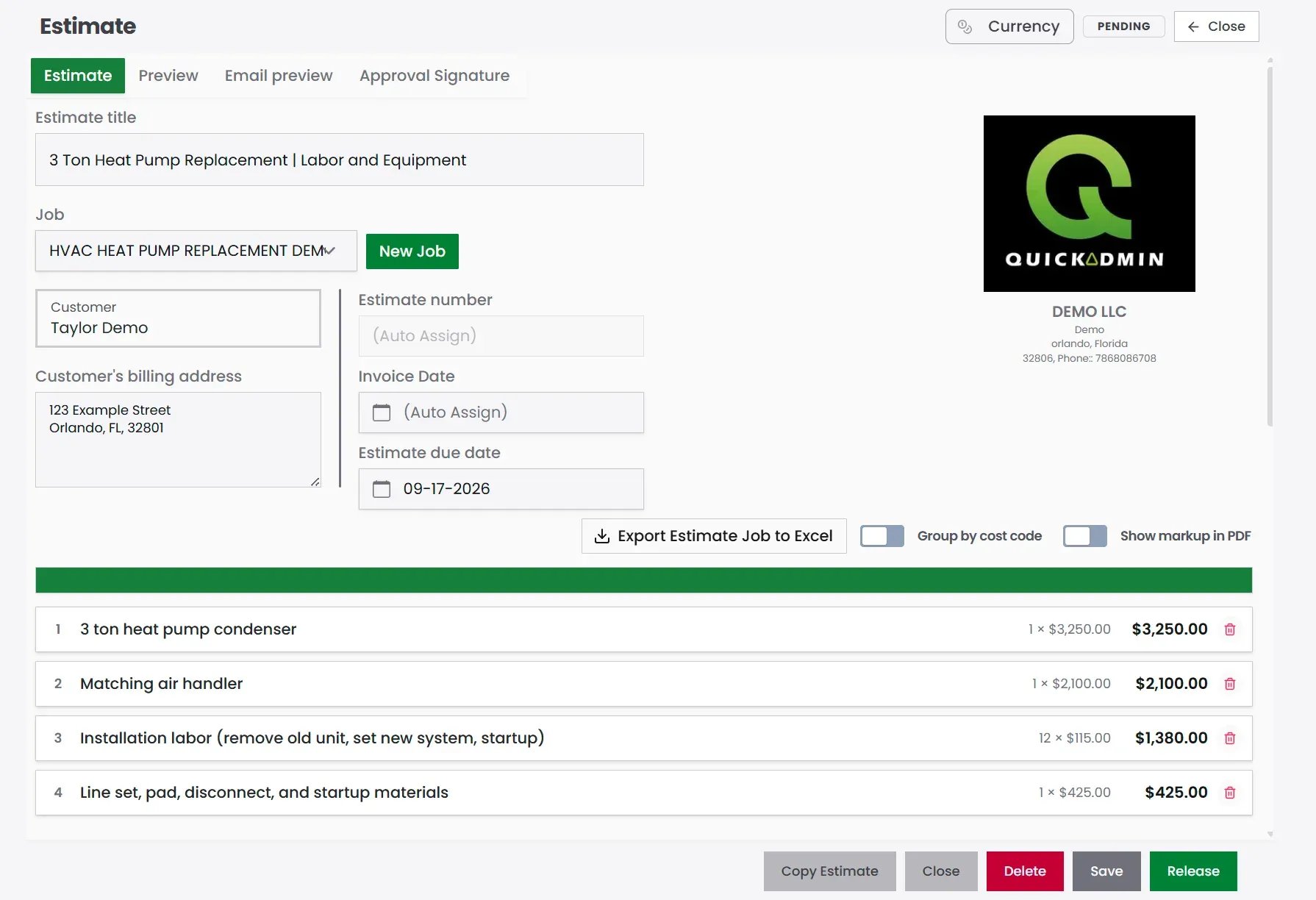
Step 2: Create the estimate inside the job

Once the job is created, create the estimate inside that job record.

Add:

  1. Estimate title.
  2. Job selection.
  3. Client.
  4. Job address.
  5. System type.
  6. Scope description.
  7. Labor.
  8. Equipment.
  9. Materials.
  10. Payment terms.
  11. Notes and exclusions.

This keeps the approved estimate connected to the right property and customer.

Step 3: Add system information

HVAC estimates are stronger when they include system details. Add:

  1. System type.
  2. Brand.
  3. Model.
  4. Serial number.
  5. Tonnage.
  6. Refrigerant type.
  7. System location.
  8. Service issue.

This helps future service calls, warranty questions, and invoice review.

Step 4: Add clear line items

Use specific line items.

Bad:

AC work

Better:

Replace failed dual run capacitor and test condenser operation

For replacement jobs, separate:

  1. Equipment.
  2. Labor.
  3. Materials.
  4. Permit.
  5. Disposal.
  6. Warranty notes.

Step 5: Add exclusions before approval

Useful HVAC exclusions include:

  1. Duct replacement not included.
  2. Electrical panel upgrade not included.
  3. Drywall repair not included.
  4. Structural modification not included.
  5. Crane service not included.
  6. Hidden code corrections not included.
  7. Additional refrigerant not included unless listed.
  8. Drain line replacement not included unless listed.
  9. Thermostat replacement not included unless listed.
  10. Maintenance plan not included unless listed.

Exclusions prevent invoice disputes.

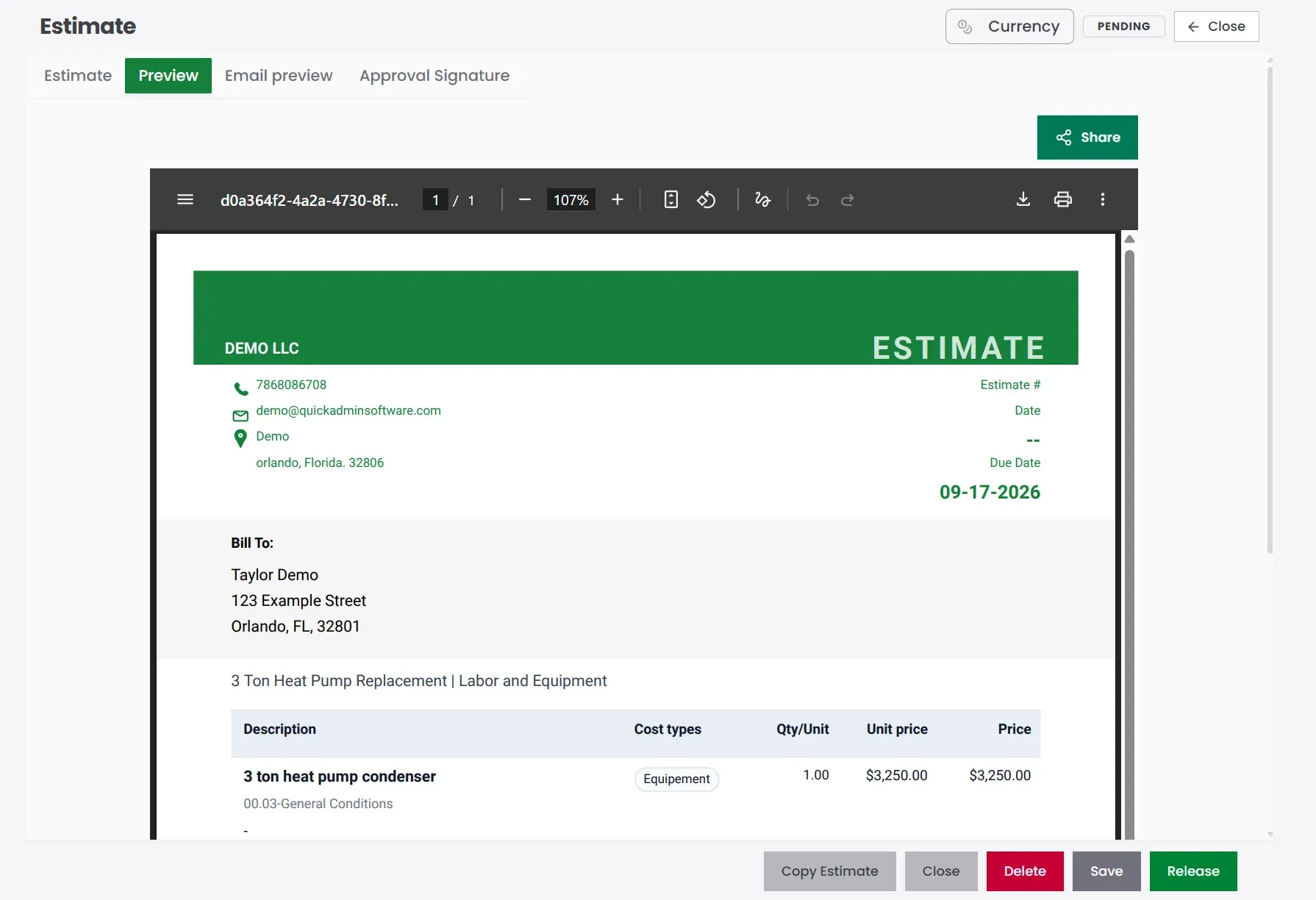
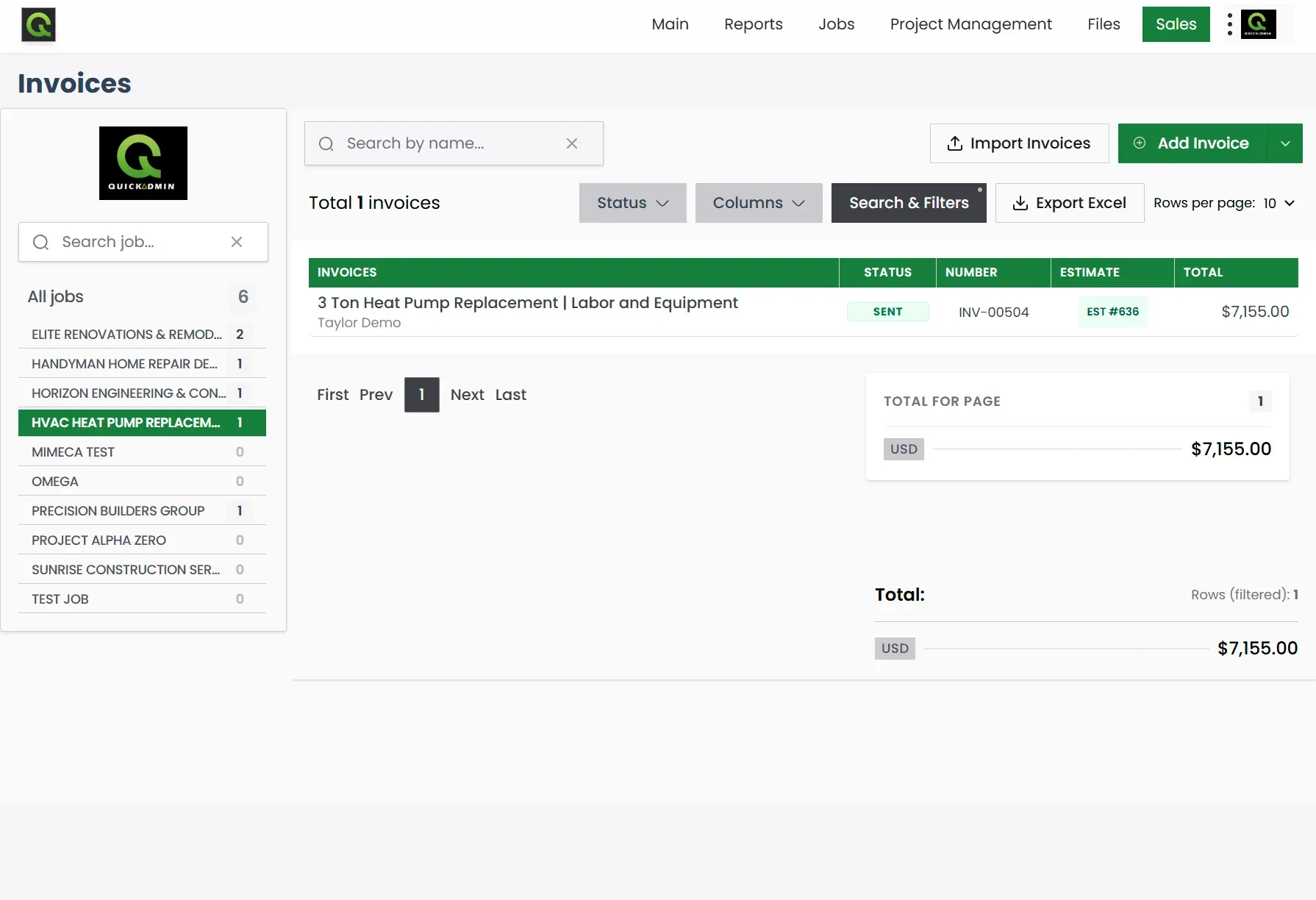
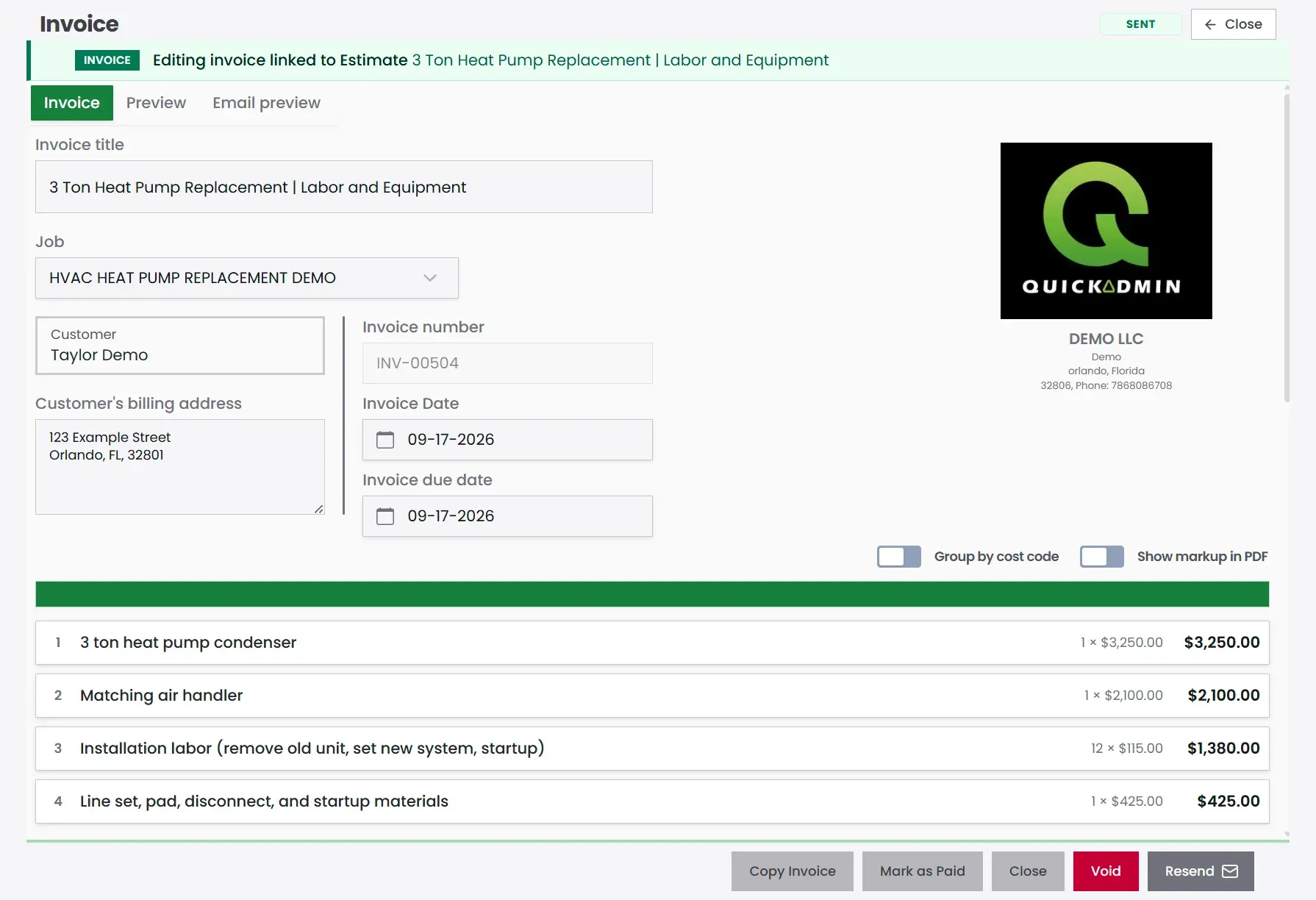
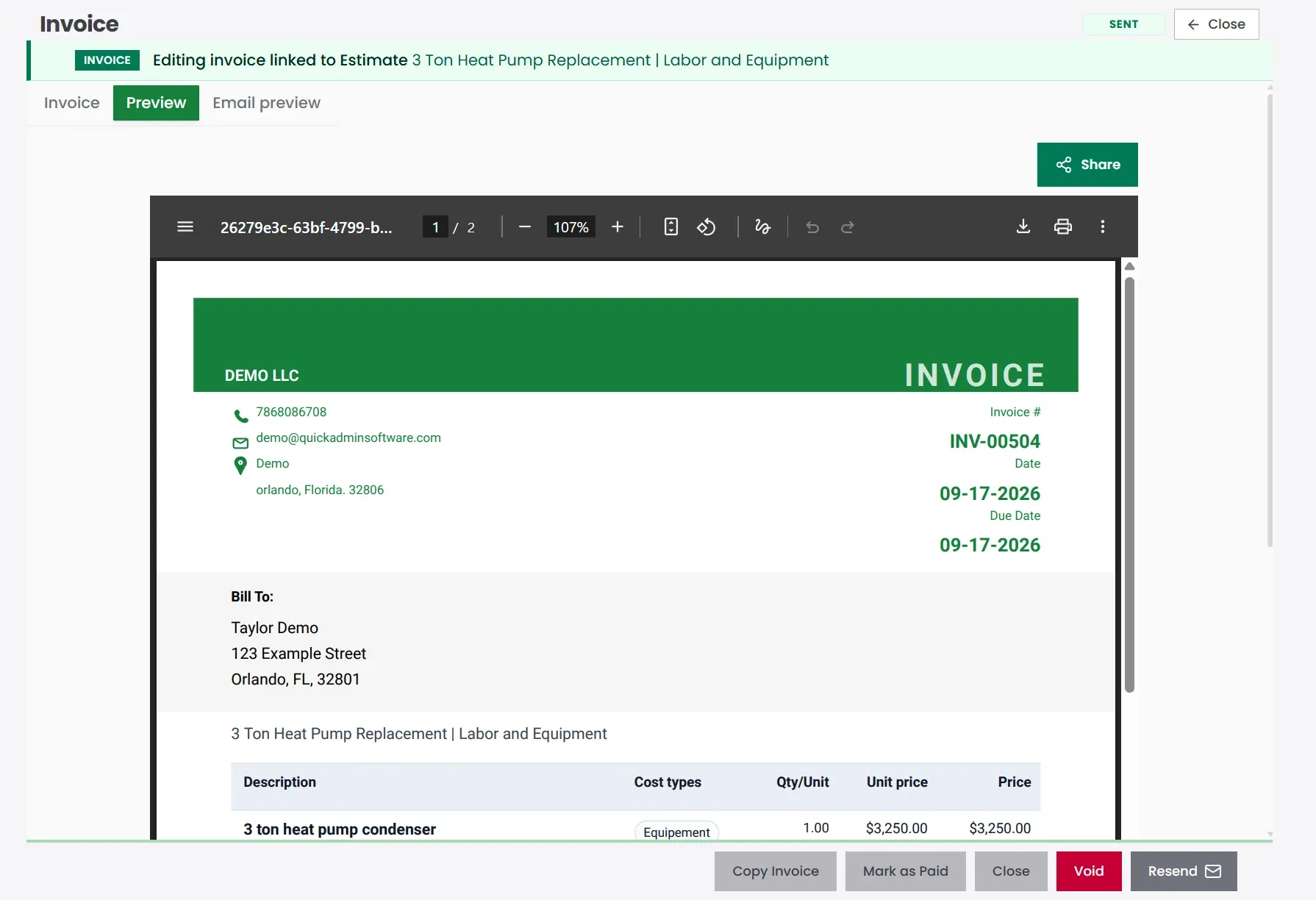
Step 6: Convert the approved estimate into an invoice

After the customer approves the estimate and the work is completed, convert it into an invoice.

The invoice should include:

  1. Invoice number.
  2. Job address.
  3. Service date.
  4. Approved scope.
  5. Equipment installed.
  6. Labor.
  7. Materials.
  8. Approved add ons.
  9. Payment terms.
  10. Balance due.

This avoids rewriting the job and helps the customer see that the invoice matches the approved work.

HVAC invoice best practices

A good HVAC invoice should make payment easy.

Show the job address clearly

This matters for:

  1. Property managers.
  2. Builders.
  3. Commercial clients.
  4. Landlords.
  5. Multi unit properties.
  6. Repeat customers.

Example:

Job address: 2200 Oak Street, Unit 204, Orlando, FL

Include equipment details

For replacements, include equipment details when available. Example:

EquipmentModelSerialWarranty note
Heat pump condenserModel listed on invoiceSerial listed on invoiceManufacturer warranty applies
Air handlerModel listed on invoiceSerial listed on invoiceManufacturer warranty applies

Recording models and serials makes future service calls and warranty claims much easier.

Separate approved add ons

If the work changed, show the add on separately. Example:

Approved add onAmount
Replace damaged disconnect box$285
Add float switch requested by customer$175
Replace thermostat$245

Do not hide approved add ons inside the final total.

Add payment terms near the balance due

As QuickBooks explains, Net 15, Net 30, and Net 60 mean payment is due 15, 30, or 60 days after the invoice date (QuickBooks invoice payments guide). For HVAC contractors, these terms work well by job type:

Job typeSuggested payment terms
Diagnostic visitDue Upon Receipt
Small repairDue Upon Receipt or Net 7
Emergency serviceDue Upon Receipt
Equipment replacementDeposit plus balance due on completion
Commercial serviceNet 15 or Net 30 if approved
Maintenance agreementMonthly, quarterly, or annual billing
Property manager workNet 7 or Net 15

Payment terms for HVAC contractors

Payment terms should match the risk you carry on each job type.

Due Upon Receipt

Best for:

  1. Diagnostic visits.
  2. Small repairs.
  3. Emergency service.
  4. One time residential customers.

Example:

Payment is due upon receipt unless different terms were approved in writing.

Deposit plus final balance

Best for equipment replacement. Example:

MilestonePayment
Deposit before equipment order40 percent
Balance due upon completion60 percent

This protects the contractor from paying for equipment before the customer commits.

Net 7 or Net 15

Best for:

  1. Repeat residential clients.
  2. Property managers.
  3. Small commercial clients.
  4. Approved accounts.

Example:

Payment is due within 15 days of the invoice date.

Monthly billing

Best for maintenance agreements. Example:

Maintenance agreement invoices are issued monthly and are due within 7 days unless different terms are approved in writing.

QuickAdmin HVAC workflow

QuickAdmin helps HVAC contractors keep the workflow organized from job to invoice.

StageQuickAdmin actionResult
Service requestCreate jobClient and job address are saved
DiagnosisAdd notes and system detailsField information stays connected
EstimateAdd labor, equipment, and materialsScope is priced clearly
ApprovalSend estimateCustomer reviews the work
Field workAdd files or approved add onsChanges are documented
BillingConvert estimate to invoiceNo duplicate entry
PaymentTrack invoice statusCash flow is easier to manage
AccountingSync with QuickBooks OnlineCleaner financial workflow

QuickAdmin is built around simplifying estimates, invoices, client management, and administrative workflows for small businesses and contractors that need practical tools without heavy technical complexity.

QuickAdmin vs simple invoice apps for HVAC contractors

A simple invoice app can help send a bill, but HVAC contractors usually need more than that. They need the estimate, job, equipment, customer, invoice, payment, and accounting workflow connected.

FeatureBasic invoice appSpreadsheetQuickAdmin
Create HVAC estimateLimitedManualYes
Convert estimate to invoiceSometimesManualYes
Save client and job addressBasicManualYes
Track system detailsNoManualYes
Add labor and equipmentManualManualYes
Add exclusions and notesLimitedManualYes
Track approved add onsManualManualYes
Track payment statusYesManualYes
QuickBooks integrationVariesNoYes
Built for contractor workflowNoNoYes

A basic invoice app creates a document; QuickAdmin connects the whole job from diagnosis to payment.

Common HVAC estimate mistakes

These mistakes can turn a good job into a payment problem.

Mistake 1: Not charging for diagnosis

Diagnosis takes skill, tools, and time. If your estimate includes diagnostic work, show it clearly. Example:

Diagnostic visit and system inspection: $125

Mistake 2: Hiding equipment details

For replacements, list the system type and equipment scope. Customers want to know what they are buying.

Mistake 3: Forgetting small materials

Drain fittings, whips, disconnects, pads, sealants, fasteners, and small electrical materials can quietly eat your margin. Price them.

Mistake 4: Not listing exclusions

A replacement estimate that does not exclude ductwork, drywall, major electrical work, or hidden code corrections can create problems later.

Mistake 5: Not documenting approved add ons

If the customer approves extra work, add it to the job before invoicing. Do not leave it in text messages.

Mistake 6: Using the same estimate for service and replacement

A $425 repair and a $9,000 replacement should not use the same structure. The risk, detail, payment terms, and approval process are different.

Copy and paste clauses for HVAC estimates

Use these clauses when needed.

Estimate validity clause

This estimate is valid for 15 days. Equipment pricing and availability may change after the validity period.

Equipment availability clause

Equipment selection is subject to supplier availability at the time of approval and deposit.

Exclusion clause

This estimate includes only the work listed above. Duct replacement, major electrical work, drywall repair, structural modification, and hidden code corrections are excluded unless listed separately.

Warranty clause

Manufacturer warranty applies according to manufacturer terms. Labor warranty applies only to work performed and listed on this invoice.

Add on clause

Additional work not included in the approved scope may require separate approval before scheduling or billing.

Maintenance clause

Maintenance service includes only the inspection and service items listed in the approved scope. Repairs, replacement parts, refrigerant, and after hours service are billed separately unless included.

These clauses are practical examples, not legal advice. For state specific HVAC licensing notices, warranty obligations, financing terms, or contract language, ask a qualified professional.

To build a stronger estimate to invoice system, read these related QuickAdmin guides:

  1. Estimate Software for Contractors
  2. How to Make an Invoice
  3. Why PWA billing and estimating is the future
  4. Job Costing Software for Small Contractors
  5. Purchase Order Software for Contractors
  6. Construction Change Order Template 2026

Conclusion: HVAC estimates should make the invoice obvious

An HVAC estimate should not be a rough number. It should explain the work clearly enough that the final invoice feels expected.

That matters because HVAC jobs can change quickly:

  • A simple repair may reveal a bigger issue.
  • A replacement may need electrical or drain work.
  • Equipment availability may change.
  • A customer may approve add ons.
  • A maintenance visit may turn into a repair.
  • A property manager may need the job address and service date before approving payment.

A better workflow handles those details early. With QuickAdmin, HVAC contractors can create the job, build the estimate, add labor and equipment, document notes and exclusions, track approved add ons, convert approved estimates into invoices, track payment status, and connect workflows with QuickBooks Online.

The playbook is simple: create the job, document the system, price the scope, get approval, complete the work, add approved changes, convert to invoice, and track payment. That is how HVAC contractors protect margin and reduce billing confusion.

FAQ

What is HVAC estimate software?

HVAC estimate software helps contractors price service calls, diagnostics, repairs, installs, equipment, labor, materials, refrigerant, permits, add ons, payment terms, and invoices from one organized workflow.

What should an HVAC estimate include?

An HVAC estimate should include client details, job address, system type, diagnosis or scope, equipment, labor, materials, permits, warranty notes, exclusions, payment terms, and estimate validity.

How do HVAC contractors turn estimates into invoices?

HVAC contractors should create the job, build the estimate inside the job, get approval, complete the work, document approved add ons, then convert the approved estimate into an invoice without rewriting the job.

What payment terms should HVAC contractors use?

Small HVAC repairs often use Due Upon Receipt or Net 7. Larger equipment replacements may use a deposit before ordering equipment and the remaining balance due at completion.

Can QuickAdmin create HVAC estimates and invoices?

Yes. QuickAdmin helps HVAC contractors create job based estimates, add labor and equipment, document add ons, convert approved estimates into invoices, track payment status, and connect workflows with QuickBooks Online.

Should HVAC invoices show equipment model details?

Yes. HVAC invoices should include equipment type, model details when available, labor, materials, warranty notes, service date, job address, payment terms, and approved extras.

Should HVAC contractors charge a diagnostic fee?

Yes. A diagnostic fee helps cover travel, technician time, testing, tools, expertise, and the work required to identify the system issue.

Does QuickAdmin integrate with QuickBooks?

Yes. QuickAdmin integrates with QuickBooks Online to help contractors streamline invoices, bills, and accounting related workflows.

Blog Categories

Related Articles

estimate software for contractors job cost report dashboard showing profit tracking

Estimate Software for Contractors: Job Costing Protects Profit

The best estimate software for contractors connects estimates, purchase orders, bills, change orders, and job costing. Track costs, invoice faster, protect profit

estimating software

How Estimate Software Improves Small Business Finances

Learn how to optimize your finances and achieve your business goals with this powerful technological solution.

Illustration of remote team members collaborating through cloud-based estimation tools, connected to a central dashboard showing client and financial data.

How Remote Teams Benefit from Cloud-Based Estimation Tools

Discover how remote teams streamline project estimation, invoicing, and collaboration using cloud-based tools. Boost productivity and accuracy with QuickAdmin Software.

Plumbing tools and blueprints on a desk representing modern estimation software

Plumbing Estimation Software (2026 Guide)

Discover how plumbing estimation software and QuickAdmin help plumbers ditch spreadsheets, create faster bids, and win more profitable jobs in 2026.

estimate software for plumbers creating a quote and invoice from a phone

Estimate software for plumbers: quote and invoice in one visit

Estimate faster, invoice the same day, and reduce disputes. This guide shows service plumbers a simple workflow using estimate software to boost cash flow.

roofer creating a roof estimate using software on a tablet 2025

Best Roofing Estimation Software (2025) — Win More Bids, Waste Less

We tested the best roofing estimation software for 2025. Compare tools that nail aerial measurements, cut takeoff time, and help you win more bids.

estimating software

Benefits of construction estimating software

Construction estimating software can be the key to a successful project. The reason lies in the benefits a technology like this can offer.

Professional illustration featuring contractors on a construction site using tablets and laptops with budgeting software. The scene includes construction blueprints, safety helmets, heavy machinery, and an organized environment showcasing innovation and efficiency in project management.

How to Improve Your Business with Estimation Software

Learn how estimation software can transform your construction business with better accuracy, efficiency, and professionalism.

drywall estimate template for small contractors with board, compound, tape, and labor line items

Drywall Estimate Template for Small Contractors

Use this free drywall estimate template to quote board, compound, tape, corner bead, fasteners, hang labor, finish labor, cleanup, tax, and payment terms clearly.

gestion de facturas por un emprendedor

Top 5 Estimate Software Features for 2025

Discover the 5 must-have features in estimate software for 2025. Save time, win trust, and grow your business with smarter quoting tools.

estimate software for drywall contractors creating a professional bid from a phone

Estimate Software for Drywall: Best Tools for Small Crews

A practical, field-first guide to choosing the best drywall estimating software for small crews in 2026 plus a scorecard, workflow, and a copy-paste estimate template you can use today.

a worker fixing an electrical panel

Estimating & Invoicing Software for Electricians 2025

Slash proposal time, generate free invoices and boost cash-flow with specialized estimate software. Our updated 2025 guide for electrical contractors provides data-backed tips

A working man in front of the computer

Construction Estimating Software Guide 2025

Choose the best construction estimating software in 2025—boost accuracy, bid faster, and raise your profits with expert tips.

painting estimate software for contractors 2026

Painting Estimate Software Guide 2026

Learn how painters create accurate estimates, convert them into invoices, track labor, and protect profit with modern estimate software.

A button with a free text

Estimate Software for Contractors Free

Looking for free estimate software for contractors? Discover how QuickAdmin helps landscapers, roofers, plumbers, and more create fast, professional estimates."

Modern and dynamic illustration of a construction site where contractors use estimating software on tablets and laptops. The scene features construction equipment, blueprints, and safety helmets, emphasizing technology integration in a professional, collaborative environment

Key features contractors should look for in estimate software

Explore essential features contractors need in estimating software. Simplify workflows, enhance accuracy, and boost profitability for your business.

The scene includes a busy plumber holding a wrench, a laptops

5 ways estimate software saves time for busy plumbers

Learn how estimation software saves plumbers time by improving quote accuracy, scheduling, and client communication. Discover 5 key benefits!

drywall estimating software for contractors 2026 with QuickAdmin estimate dashboard, drywall worker finishing a wall, material lists, labor costs, quotes, invoices, and QuickBooks integration

Best Drywall Estimating Software for Small Contractors (2026)

Compare the best drywall estimating software for small contractors in 2026. See takeoff tools, pricing, and how QuickAdmin connects estimate, change order, invoice, purchase order, and job costing.

A contractor visits a house where he works

How to Price Drywall Jobs: A Contractor’s Guide to Profits

Learn how to price drywall jobs accurately. Discover cost factors, labor rates, and profit margins to create competitive bids and maximize your earnings.

Contractors comparing prices using estimate software integrated with Home Depot

Best Construction Estimate Software 2025 | Home Depot

Discover how QuickAdmin’s estimate software improves accuracy, saves time, and connects directly with Home Depot pricing for smarter, more profitable bids in 2025.

Digital illustration showing cloud-based invoicing with a woman using a laptop and a man using a smartphone, surrounded by floating digital invoices connected to a cloud platform.

Free Estimate Software for Small Businesses

Discover how free estimate software helps small businesses streamline operations, create accurate quotes faster, improve cash flow, and win more projects. Learn the key features and benefits today!

Free invoice and estimate tools running on a laptop used by a small business contractor

Boost Your Business Efficiency with Free Invoice and Estimate Tools

Boost your business efficiency with free invoice and estimate tools that automate billing and streamline your workflow.

concrete estimate software for small contractors 2026

Concrete Estimate Software for Contractors

Learn how small concrete contractors estimate slabs, driveways, footings, labor, materials, markup, and invoices with less profit leakage.

businessman pushing away problems

Top 5 mistakes to avoid when creating estimates for clients

Avoid these mistakes to improve your services, streamline workflows, and build stronger client relationships. Discover tips to enhance estimating!

contractor measuring walls and calculating sheets to estimate a drywall job

How to Estimate a Drywall Job (Step by Step)

Learn how to estimate a drywall job step by step: measure walls and ceilings, calculate square footage, add a waste factor, convert to sheets, and estimate compound, tape, bead, and labor hours.

landscaping estimate template and invoice workflow for contractors 2026

Landscaping Estimate Template and Invoice Workflow

Use this landscaping estimate template to price labor, materials, maintenance, installs, add ons, invoices, and recurring work clearly.

customize estimating software

Ways to customize your estimating software for different market needs

Customize your estimating software to improve budgeting, scheduling, and resource management across different industries and project types.

A business owner reviews a digital estimate on a laptop and tablet in a bright, modern office setting, surrounded by documents, charts, and coffee, indicating productivity and financial management. The estimate on the screens features clear, itemized costs and the QuickAdmin logo

Pros and Cons of Free Estimate Software for Small Businesses

Discover the advantages and disadvantages of free estimate software and find out if it's right for your small business.

Contractor using cloud-based invoice and estimate software on a tablet at a construction site

Cloud-Based Invoicing and Estimate Software

Discover how cloud-based estimate software helps contractors and freelancers streamline billing, improve accuracy, and grow profits with less effort

a contractor in the office make a estimate software

Contractor Estimate Software

Discover the best estimation and invoicing software for contractors. Boost accuracy, automate workflows, and scale your business faster with digital tools.

Interior Designer

How Estimate Software Enhances Workflow for Interior Designers

Discover how modern estimating software transforms the work of interior designers and improves accuracy, efficiency and communication.

free sale sign advertisement concept

Best Features of a Free Estimate Software

Customizing your estimate software can enhance your project's budgeting, scheduling, and resource management with tailored tools and features.

A business owner reviews a digital estimate on a laptop and tablet in a bright, modern office setting, surrounded by documents, charts, and coffee, indicating productivity and financial management. The estimate on the screens features clear, itemized costs and the QuickAdmin logo

Plumber Estimate Software to Cut Costs and Win More Jobs

Improve estimates, reduce errors, and cut costs with plumber estimate software. Learn features, ROI benefits, and how to pick the right tool.

drywall estimate software for contractors 2026

Drywall Estimate Software Guide (2026 Edition)

Discover how to estimate and invoice drywall jobs accurately using modern estimate software. Stop profit leaks, reduce errors, and get paid faster with a 2026 workflow.